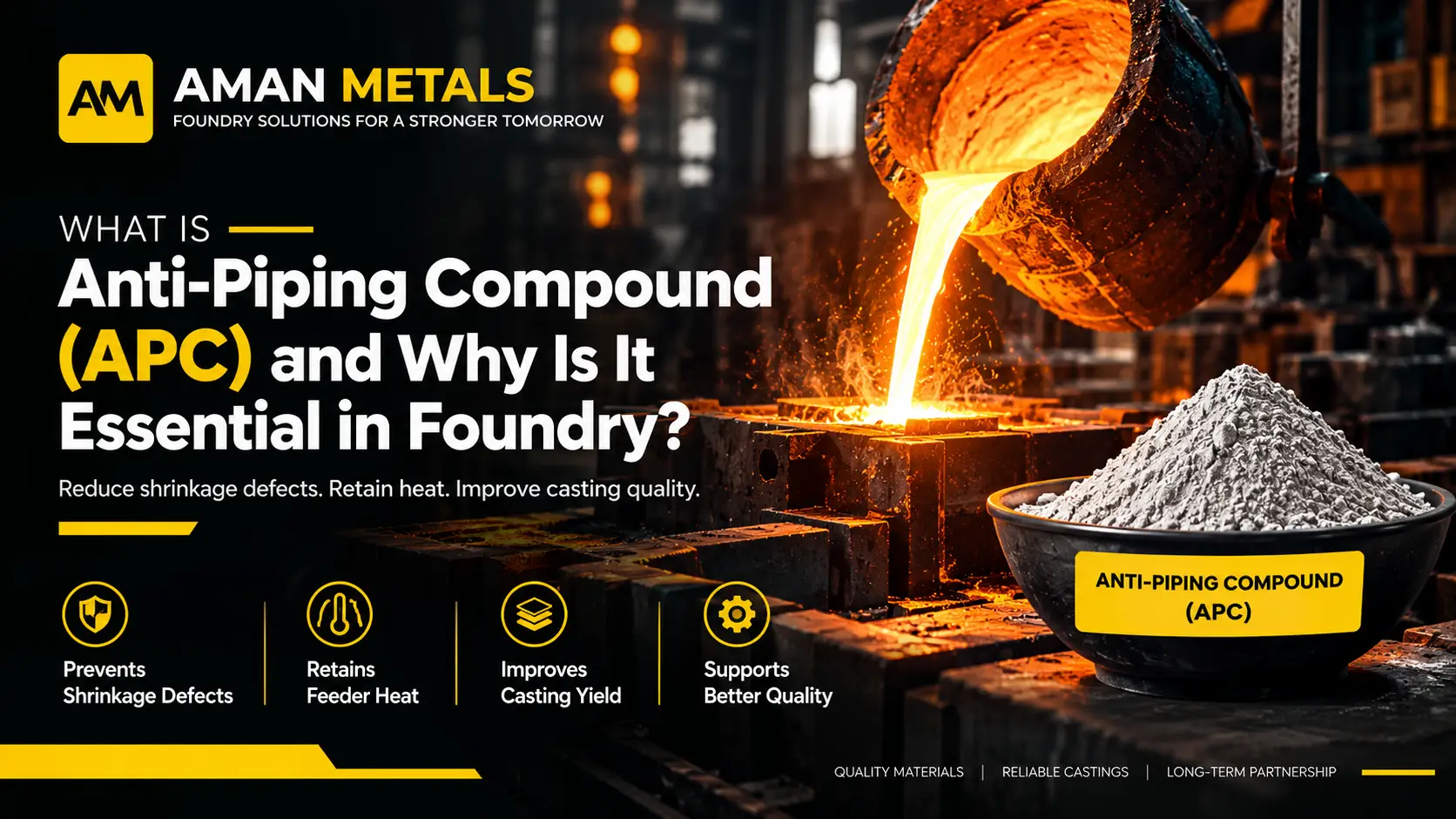
What Is Anti-Piping Compound (APC) and Why Is It Essential in Foundry?
Introduction
In the metal casting industry, producing strong, reliable and defect-free castings is one of the most important goals for every foundry. Whether manufacturing industrial components, automotive parts, engineering products or metal castings for heavy machinery, foundries must maintain control over molten metal temperature, solidification and feeding. Even small defects can affect the quality, strength, appearance and usability of the final casting.
One common challenge in casting operations is shrinkage-related defects. These defects can develop when molten metal contracts during solidification and the casting does not receive sufficient additional liquid metal to compensate for the volume reduction. In some situations, this can result in shrinkage cavities or piping near the feeder or riser.
This is where Anti-Piping Compound (APC) can play an important role. APC is a specialized exothermic and insulating material used in foundry applications to help maintain heat around the feeder head, support effective metal feeding and reduce the risk of piping-related defects when correctly selected and applied.
At Aman Metals, we understand the importance of reliable foundry materials in supporting casting performance. In this guide, we explain what Anti-Piping Compound is, how it works, its benefits, applications and the important factors foundries should consider when selecting and using it.
1. What Is Anti-Piping Compound (APC)?
Anti-Piping Compound, commonly known as APC, is a foundry consumable designed to help reduce piping and certain shrinkage-related problems in metal casting. It is generally applied over the molten metal surface in a feeder head or riser according to the product’s recommended application procedure.
Depending on its formulation, APC can combine exothermic properties with thermal insulation. An exothermic reaction releases heat, while an insulating layer slows heat loss from the molten metal surface. Together, these functions can help maintain a suitable thermal condition in the feeder for a longer period.
During casting, molten metal cools and solidifies. As it changes from liquid to solid, it generally undergoes volumetric contraction. The feeding system must provide sufficient liquid metal to compensate for this contraction. If the feeder solidifies too early or cannot supply enough liquid metal, shrinkage defects may develop.
An appropriately selected Anti-Piping Compound helps support the feeding process by keeping the feeder area hot for longer. The exact performance depends on the compound formulation, metal type, casting design, pouring temperature and foundry operating conditions.
Why Is APC Important?
APC is used as part of a wider casting-quality strategy. It may help foundries:
- Maintain heat around the feeder head.
- Support directional solidification and effective feeding.
- Reduce the likelihood of piping-related defects under suitable conditions.
- Improve the utilization of molten metal.
- Reduce avoidable casting rejections when combined with good process control.
It is important to understand that APC is not a universal solution for every casting defect. Correct feeder design, gating, pouring practices and process monitoring remain essential.
2. How Does Anti-Piping Compound Work?
To understand the role of APC, it helps to look at the solidification process.
When molten metal enters a mould, it begins losing heat to the mould material and surrounding environment. Different sections of the casting cool at different rates, depending on their size, shape, material and thermal conditions.
In many casting designs, a feeder or riser acts as a reservoir of liquid metal. It supplies additional metal to the casting as the metal contracts during solidification. For this system to work properly, the feeder needs to remain liquid long enough to perform its feeding function.
Anti-Piping Compound supports this process through two main mechanisms.
A. Exothermic Heat Generation
Exothermic materials are formulated to release heat through a controlled chemical reaction when exposed to the appropriate conditions. In suitable applications, the heat released can help delay cooling of the feeder metal.
By helping the feeder remain hot for longer, an exothermic compound can support the feeding process during the critical solidification period.
The reaction characteristics vary according to the formulation. Foundries should always follow the manufacturer’s instructions regarding application quantity, handling and suitability for a particular alloy and process.
B. Thermal Insulation
The insulating properties of APC help reduce heat loss from the exposed molten metal surface. Instead of allowing the feeder to cool rapidly, the compound creates a layer that helps retain thermal energy.
This can contribute to a more favourable temperature relationship between the feeder and the casting.
C. Supporting Effective Feeding
Exothermic action and thermal insulation work together to support the feeder’s function. When the feeder remains liquid for the required duration and the casting design allows proper feeding, the risk of certain shrinkage-related defects may be reduced.
However, results depend on the complete casting system. If the feeder is incorrectly sized, the feeding path is blocked, or the casting design creates isolated hot spots, applying APC alone may not resolve the problem.
3. Key Benefits of Anti-Piping Compound in Foundry
Selecting a suitable APC can provide several potential advantages in metal casting operations.
1. Helps Reduce Piping-Related Defects
Piping is associated with the formation of a depression or cavity in the feeder region as molten metal contracts during solidification. APC helps maintain heat at the feeder surface, which may reduce the risk of premature cooling and support a more effective feeding process.
The actual reduction in defects depends on feeder design, material properties and operating conditions.
2. Supports Improved Casting Yield
Casting yield refers to the proportion of poured metal that becomes usable casting material. Feeding systems consume metal that may later be removed from the casting.
By supporting more effective feeding and helping reduce avoidable defects, a suitable APC may contribute to improved process efficiency. The extent of any yield improvement should be established through production trials and measured results.
3. Helps Retain Heat in the Feeder
Maintaining the feeder’s thermal condition is important for supplying liquid metal during solidification. APC’s exothermic and insulating characteristics can help retain heat and delay premature solidification.
This can be particularly useful where the casting design and production conditions benefit from an extended feeding period.
4. Supports Better Casting Quality
Shrinkage defects can affect the internal integrity, surface appearance and usability of cast components. By supporting the feeding system, APC may help reduce certain defects and contribute to more consistent casting quality.
Quality outcomes also depend on alloy selection, mould preparation, pouring practice, melting control and inspection procedures.
5. Can Help Reduce Rework and Rejection
Defective castings may require additional inspection, repair, remelting or disposal. These activities increase manufacturing costs and consume production time.
If APC is correctly selected and incorporated into a well-controlled process, it may help reduce some feeding-related defects and the associated costs.
6. Supports Process Consistency
Foundries benefit from repeatable processes. Standardized material selection, application procedures and quality checks help reduce unnecessary variation.
Using a suitable APC with documented operating instructions can form part of a consistent foundry process.
4. Applications of Anti-Piping Compound
Anti-Piping Compound is used in foundry operations where feeder performance, heat retention and shrinkage control are important considerations.
Potential applications include the following.
Ferrous Metal Casting
Foundries producing iron and steel castings may use exothermic or insulating feeder materials to support solidification and feeding. The specific APC formulation must be suitable for the alloy and process.
Industrial Castings
Industrial components can have complex geometries and varying section thicknesses. These differences influence cooling rates and feeding requirements. APC may be considered where feeder heat retention is needed.
Engineering Components
Cast engineering components may require reliable internal integrity and dimensional consistency. Suitable feeder materials can support the overall casting process when used with an appropriate mould and feeding design.
Heavy and Large Castings
Larger castings can present challenging thermal conditions because different regions cool at different rates. Foundries may evaluate APC as part of their strategy for maintaining feeder temperature and controlling shrinkage-related defects.
Production Foundries
Foundries producing repeated batches may evaluate APC through controlled trials to establish application quantities, operating procedures and measurable quality outcomes.
Important: Not every APC product is suitable for every metal, casting size or moulding system. Confirm the grade’s com